

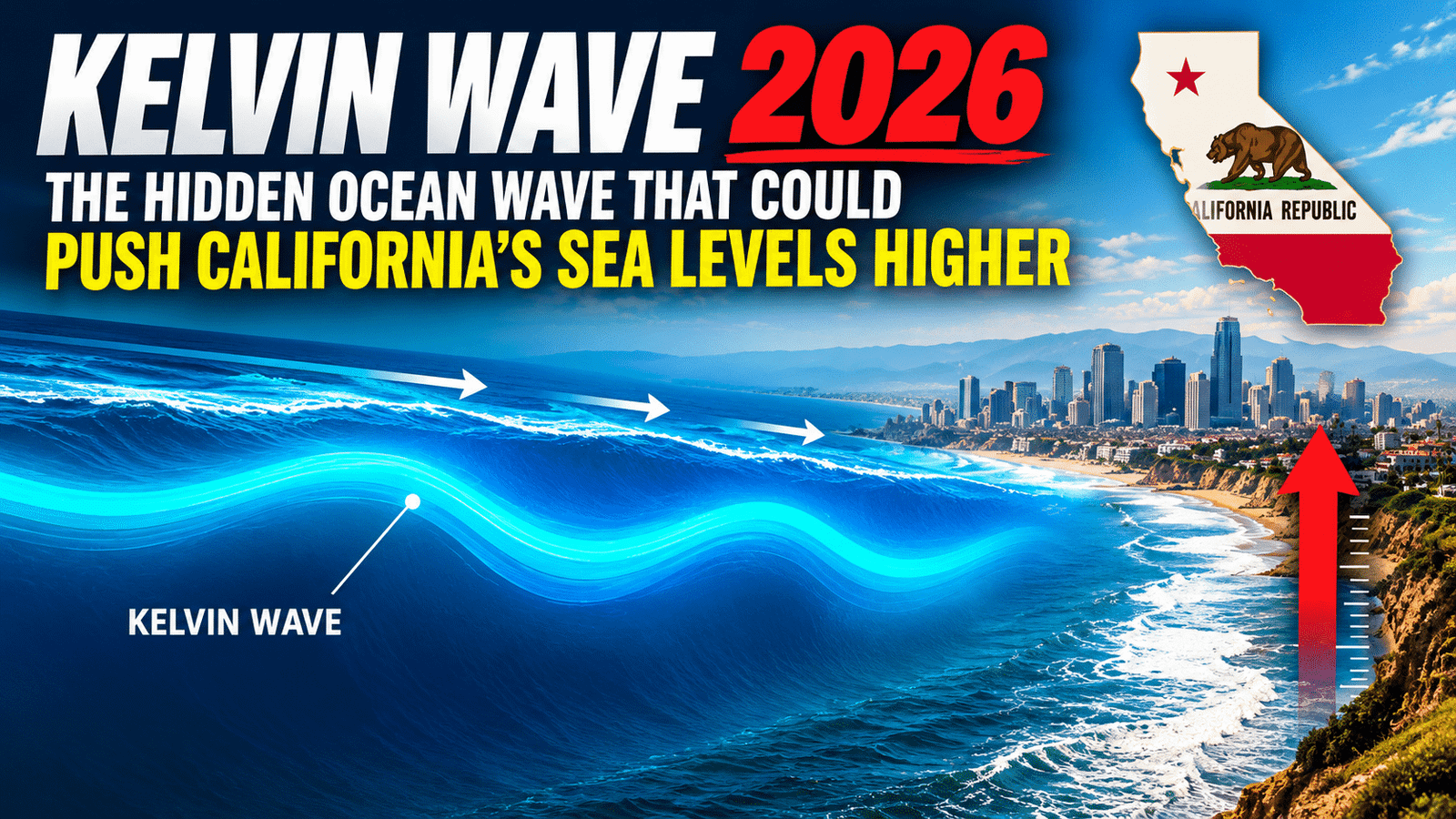
Kelvin Wave 2026: What It Is and Why California Should Pay Attention
The Kelvin wave 2026 has become one of the most talked-about ocean phenomena of the year, as a record-breaking El Niño intensifies across the Pacific. Scientists first began tracking it using satellite data back in spring 2026. However, the story isn’t as simple as a single dramatic wave. It’s a slow-moving, weeks-long rise in sea level that experts say deserves attention, not alarm.
What Exactly Is a Kelvin Wave
A Kelvin wave 2026 is not a wave you can see or surf. According to researcher Reineman, it’s essentially piled-up water sloshing back and forth across the Pacific Ocean.
Here’s how it forms:
- Trade winds normally blow steadily west across the equator, piling up water on the western side of the Pacific.
- During El Niño conditions, those winds weaken or reverse in bursts.
- That shift sends warm water traveling east across the Pacific toward the Americas.
Additionally, NASA describes these as low, wide waves, sometimes hundreds of kilometers across, detected using satellite altimeters that measure ocean surface height.
How the 2026 Kelvin Wave Has Developed
Early Detection
Satellites first tracked the emerging Kelvin wave 2026 in spring, with NASA’s Sentinel-6 Michael Freilich satellite observing a swell of warm water arriving off South America in May. This early signal helped confirm that a significant El Niño was likely to develop later in the year.
A Powerful Subsurface Engine
By September, tracking showed a strong downwelling Kelvin wave beneath the surface, with temperature anomalies more than 10 degrees Celsius above normal in the top 650 feet of the ocean. As a result, this subsurface warmth has become a key driver of what forecasters are now calling a potential “Super El Niño” for winter 2026-2027.
Why California Is Watching Closely
Rising Sea Levels
A coastally trapped Kelvin wave, moving north at roughly 6 mph, has been approaching California’s coast. Researchers say it could temporarily raise sea levels by 6 to 12 inches over weeks or months.
Compounding Risks
However, the real concern isn’t the wave alone. It’s what happens when it combines with other seasonal factors:
- King tides expected around Thanksgiving and Christmas
- Winter storms associated with El Niño
- Ongoing coastal erosion from earlier storm damage
Consequently, officials have flagged an elevated risk of coastal flooding, beach erosion, and damage to infrastructure like the Pacific Coast Highway, parts of which were already damaged by heavy waves over Labor Day weekend.
Reported Emergency Preparations
Some outlets report that California Governor Gavin Newsom has declared a state of emergency in connection with the anticipated coastal impacts, and that the California Coastal Commission is encouraging residents to inspect vulnerable areas, install drainage systems, and prepare for severe weather. However, this specific claim comes from a single source, so readers should verify current emergency declarations through official California state channels before treating it as confirmed.
Why Experts Urge Caution About the Hype
Not everyone agrees the Kelvin wave 2026 deserves the level of alarm it’s getting in some headlines. Meteorologist Marshall Shepherd, writing for Forbes, pointed to a 2015 NOAA piece asking whether Kelvin waves could become “the ocean version of the polar vortex” — a term that often gets used as a media buzzword without being properly explained.
Therefore, while the science behind Kelvin waves is real and well-documented, some coverage may overstate the immediate danger compared to what climate scientists are actually observing.
What This Means for Winter 2026-2027
Because El Niño winters typically shift the Pacific jet stream, California could see wetter conditions than usual this season. Forecasters project the current event will peak between November and December, which lines up closely with the king tide season mentioned earlier.
Common Questions About the Kelvin Wave 2026
Is a Kelvin wave like a tsunami?
No. Scientists describe it as a slow-moving rise in sea level, not a fast, destructive wave.
How is the Kelvin wave tracked?
NASA uses the Sentinel-6 Michael Freilich satellite, which measures ocean height using radar altimeters.
When will the 2026-2027 El Niño peak?
Forecasters project a peak between November and December 2026.
Common Mistakes to Avoid
- Don’t confuse a Kelvin wave with a tsunami or a single dramatic ocean swell.
- Don’t assume every headline about it is equally reliable; some coverage may overstate near-term risk.
- Don’t overlook the compounding effect of king tides and storms, which matter as much as the wave itself.
Conclusion
The Kelvin wave 2026 reflects a real and well-documented part of how El Niño develops, and its potential to raise sea levels along the California coast is worth taking seriously. At the same time, experts caution against treating it as an isolated, sudden threat rather than one factor in a broader seasonal pattern. As the record-setting El Niño continues intensifying toward its expected winter peak, keeping an eye on official coastal advisories remains the most reliable way to stay prepared.