
$11 Billion Student Loan Settlement: What Borrowers Need to Know in 2026
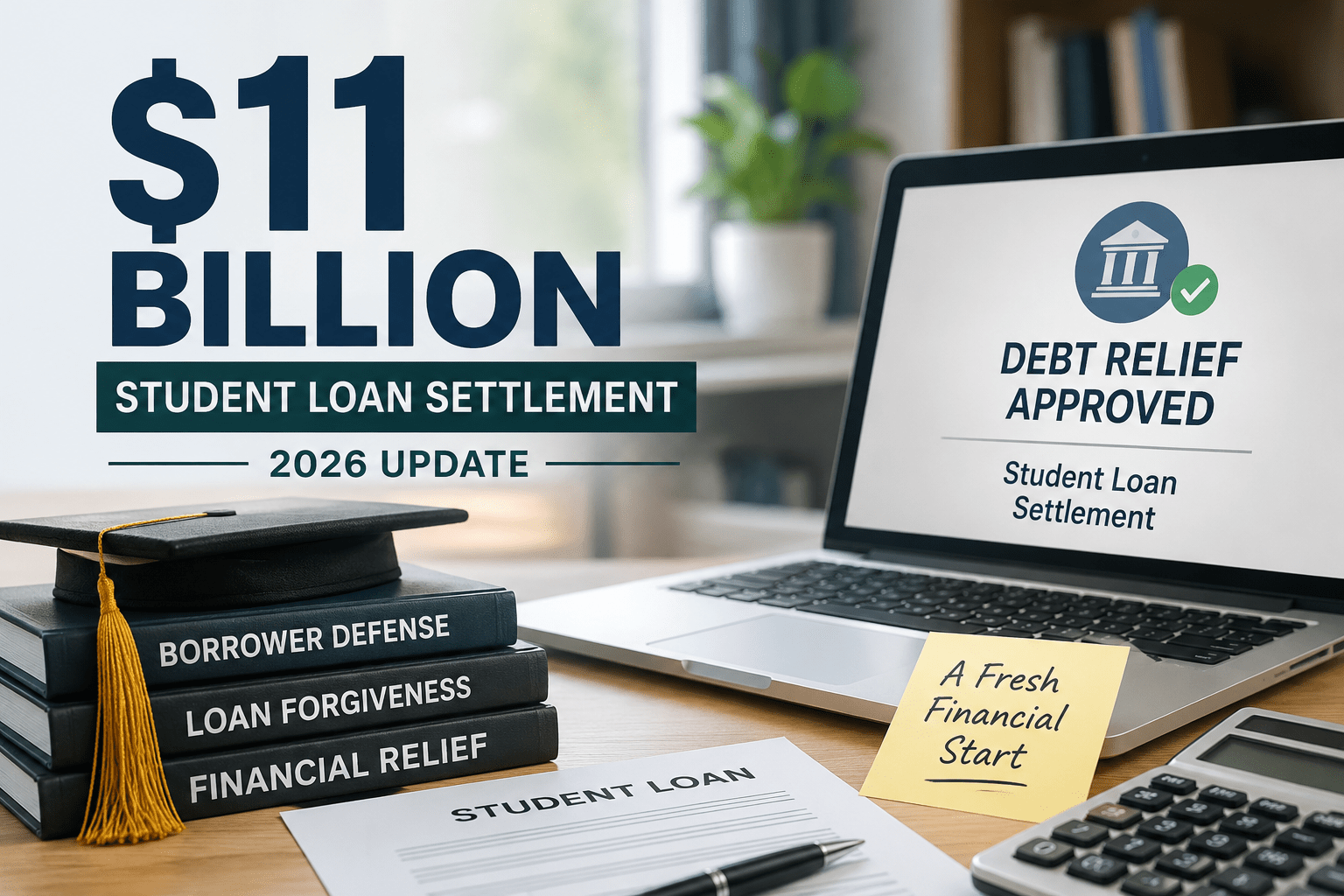
The $11 billion student loan settlement is making headlines across the United States this week. As a result, more than 170,000 borrowers are set to have their federal student loans wiped out completely. This news comes after a federal appeals court blocked an attempt to delay relief that many borrowers had waited years to receive.
If you attended a school accused of misconduct or fraud, this update could directly affect you. Below, we break down what happened, who qualifies, and what to do next.
Why the $11 Billion Student Loan Settlement Matters
This settlement is not a small policy tweak. Instead, it represents one of the largest relief actions ever taken against the U.S. government. As a result, the total value of the broader class-action case now stands at roughly $23 billion, covering nearly 500,000 borrowers.
Additionally, this ruling shows that courts are willing to hold federal agencies accountable to settlement deadlines. Consequently, borrowers who felt ignored for years now have a legal pathway to relief.
Key Factors Behind the Ruling
The Legal Background
The $11 billion student loan settlement traces back to Sweet v. McMahon (formerly Sweet v. Cardona). This case relies on the borrower defense rule, which lets students cancel federal loans if their school misled them about outcomes, accreditation, or job placement.
The Missed Deadline
The Education Department was required to decide pending claims by early 2026. However, it missed that deadline. As a result, the department requested an 18-month extension.
The Court’s Decision
A district judge denied the extension request. Furthermore, the 9th U.S. Circuit Court of Appeals upheld that decision in July 2026, clearing the way for automatic discharge.
Who Qualifies for This Relief
Borrowers covered under this specific settlement round include those who:
- Submitted a borrower defense application between June 23, 2022, and November 15, 2022
- Had claims that remained undecided past the required deadline
- Attended schools linked to claims of substantial misconduct
However, not everyone with student debt qualifies automatically. Borrowers who applied outside this window should not assume they are included.
Types of Student Loan Relief Available
Automatic Discharge
Some borrowers will see their loans canceled automatically through StudentAid.gov, without needing to take further action.
Ongoing Borrower Defense Applications
Borrowers outside the settlement class can still apply separately if their school engaged in fraud or misconduct.
Refunds for Prior Payments
In many cases, borrowers who already made payments toward discharged loans may be eligible for reimbursement.
What Borrowers Should Do Next
- Check StudentAid.gov regularly for updated account status.
- Watch your email for official notices from Federal Student Aid.
- Avoid third-party scams promising faster processing for a fee.
- Contact your loan servicer if your balance doesn’t update within a reasonable time.
Common Mistakes to Avoid
- Assuming every federal loan is automatically included in the $11 billion student loan settlement
- Ignoring emails from StudentAid.gov as spam
- Paying third parties for “settlement processing” services
- Missing verification steps if requested by the Department of Education
Staying Updated on Your Loan Status
Since this situation is still developing, borrowers should monitor official government sources rather than social media rumors. Additionally, checking your credit report periodically helps confirm that discharged balances are properly removed.
Here’s just the Frequently Asked Questions section, with the focus keyword used exactly 8 times.
Frequently Asked Questions
1. What is the $11 billion student loan settlement?
The $11 billion student loan settlement refers to a court-ordered discharge of federal student debt tied to the Sweet v. McMahon case. It stems from the borrower defense rule, which lets students cancel loans if their school misled them about outcomes, accreditation, or job placement.
2. Who qualifies for the $11 billion student loan settlement?
Borrowers who submitted a borrower defense application between June 23, 2022, and November 15, 2022, and whose claims remained undecided past the required deadline, are covered under this settlement.
3. Do I need to apply for this relief?
No. Eligible borrowers do not need to submit a new application. Relief under the settlement should appear automatically in their StudentAid.gov account once processed.
4. Will I get a refund for past payments?
Yes, in many cases. Borrowers who already made payments toward loans now being discharged under the $11 billion student loan settlement may qualify for reimbursement.
5. How can I check my settlement status?
Log into StudentAid.gov regularly and watch for official emails from Federal Student Aid. Avoid third-party companies charging fees to speed up the process.
6. Is the $11 billion student loan settlement the same as general loan forgiveness?
No. This settlement is separate from programs like Public Service Loan Forgiveness. It applies only to borrower defense claims filed within a specific window between 2022 and 2026.
7. Why did the $11 billion student loan settlement happen now?
A federal appeals court rejected the Education Department’s request to delay relief by 18 months, which triggered automatic discharge for eligible borrowers in 2026.
8. What should I do if my loan balance hasn’t updated yet?
Contact your loan servicer directly and confirm your eligibility for the $11 billion student loan settlement through your StudentAid.gov account before assuming there is an error.
Conclusion
The $11 billion student loan settlement marks a major victory for defrauded borrowers and reinforces accountability within the federal loan system. As this case continues to unfold in 2026, affected borrowers should stay alert, verify their eligibility, and rely only on official channels for updates. If you believe you qualify, check your StudentAid.gov account today to see where you stand.