

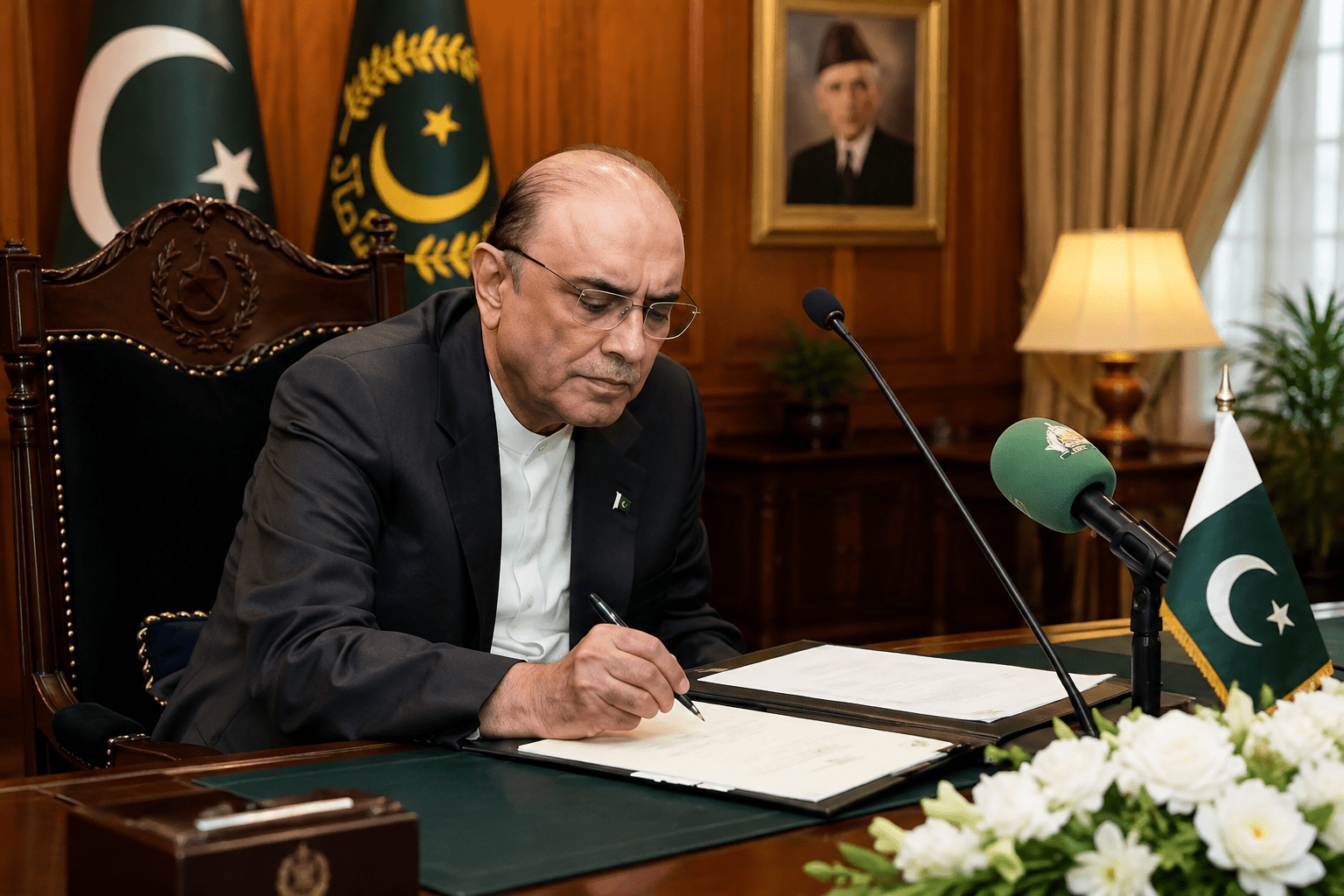
President Zardari Judicial Appointments: 2026 Update
President Asif Ali Zardari’s judicial appointments decision on August 11, 2026, has ended a weeks-long standoff between the Presidency and the federal government. As a result, Pakistan’s judiciary can now move forward with much-needed staffing across five high courts. This president zardari judicial appointments update matters for global readers tracking Pakistan’s legal and constitutional developments.
The dispute began in July 2026, when the Judicial Commission of Pakistan (JCP) recommended new judges. However, the summaries remained unsigned for weeks, raising concerns about institutional delays.
Why the President Zardari Judicial Appointments Matter
Judicial appointments directly affect how quickly courts can process cases. Additionally, delays in appointments can create backlogs that hurt everyday citizens seeking justice.
- Vacant judicial seats slow down case resolution
- Public trust in courts depends on timely staffing
- Constitutional bodies like the JCP need swift presidential action to function properly
As a result, the president zardari judicial appointments story is being closely watched by legal experts, journalists, and international observers interested in Pakistan’s rule of law.
Key Factors Behind the Decision
The Judicial Commission’s Role
The JCP met on July 20 and July 21, 2026, recommending 19 additional judges along with confirmations for five others. However, approval stalled for several weeks afterward.
Islamabad High Court Pressure
Notably, the Islamabad High Court (IHC) had been hearing a petition challenging the delay. The court sought written explanations from both the federal government and the Ministry of Law, which likely accelerated the final decision on president zardari judicial appointments.
Behind-the-Scenes Coordination
According to reports, PM’s Adviser Dr. Syed Tauqeer Shah and National Assembly Speaker Sardar Ayaz Sadiq played a “special role” in resolving the deadlock. Consequently, the impasse ended just one day after the IHC’s intervention.
Breakdown of the New Appointments
The president zardari judicial appointments cover five provincial high courts. Here’s the distribution:
- Lahore High Court (LHC): 10 additional judges appointed; 1 confirmed as permanent
- Sindh High Court (SHC): 3 additional judges appointed; extension granted to 1 judge; confirmations approved
- Islamabad High Court (IHC): 3 additional judges appointed
- Balochistan High Court (BHC): 3 additional judges appointed
- Peshawar High Court (PHC): 4 additional judges confirmed as permanent
Therefore, this brings the total to 19 new appointments plus 5 confirmations, resolving nearly all pending JCP recommendations.
Additional Reforms Alongside the Appointments
Beyond judicial appointments, President Zardari also approved related reforms. For instance, he equalized Supreme Court judges’ salaries, allowances, and pensions with those of the Federal Constitutional Court. Furthermore, amendments to the 1997 order governing high court judges’ leave and pension benefits were also signed.
Separately, [internal link: Pakistan political news] Zardari approved Haroon Akhtar as Adviser to PM Shehbaz Sharif on Industries and Production—a move unrelated to the judiciary but announced the same day.
Common Misunderstandings to Avoid
Readers should avoid a few mistakes when interpreting the president zardari judicial appointments news:
- Confusing “additional” with “permanent” judges — these are distinct legal statuses under Pakistani law
- Assuming all JCP recommendations were approved — some confirmations remain court-specific
- Overlooking the constitutional timeline — delays beyond prescribed periods raise separate legal questions, as the IHC noted
What Happens Next
Following presidential approval, the Ministry of Law and Justice has already issued formal notifications. [External link: Judicial Commission of Pakistan official site] Going forward, legal analysts expect smoother functioning across the five high courts, provided future JCP recommendations are processed without similar delays.
Conclusion
The president zardari judicial appointments decision marks a significant step toward strengthening Pakistan’s judicial system. By clearing 19 pending appointments and 5 confirmations, President Zardari has resolved a dispute that had drawn court scrutiny and public attention. As Pakistan’s judiciary moves forward, readers worldwide should continue following how president zardari judicial appointments shape the country’s legal landscape in the months ahead.